Susan is a licensed insurance agent and has worked as a writer and editor for over 10 years across a number of industries. She has worked at The Zebr…
 Credentials
- Licensed Insurance Agent — Property and Casualty

Beth joined The Zebra in 2022 as an Associate Content Strategist. A licensed insurance agent, she specializes in creating clear, accessible content t…
Credentials
- Licensed Insurance Agent — Property and Casualty
- Associate in Insurance (AINS)
- Professional Risk Consultant (PRC)
- Associate in Insurance Services (AIS)

Renata joined The Zebra in 2020 as a Customer Experience Agent. Since 2021, she has worked as a licensed insurance professional and content strategis…
Credentials
- Licensed Insurance Agent — Property and Casualty
- 5 years of experience in the insurance industry
How Much Is Car Insurance in 2026?
The average annual premium for Americans is now $2,256. This is a 3% increase over the previous year. Not surprisingly, the cost of car insurance has continued to rise. After all, most things get more expensive, not less. However, in encouraging news, the degree of rise is significantly less steep than in recent years.
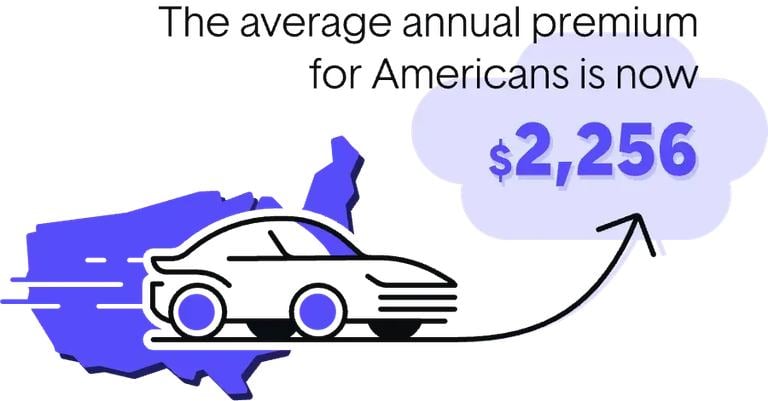
From 2021 until 2024, Americans saw big increases in car insurance premiums. While the average annual premium nationally did increase from 2024 to 2025, it was a much smaller gain than between 2023 and 2024.
Source: The Zebra

The Most and Least Expensive States for Auto Insurance in 2026
The average auto insurance cost for the U.S. is an interesting number, but it doesn’t really tell the full story. Insurance is a state-regulated industry, and each state has their own unique risk factors that can change what you pay for car insurance just by living there – regardless of who you are or how you drive.
Source: The Zebra
Key Findings by State
- 21 states and the District of Columbia saw their insurance decrease last year from the previous year. These decreases were by as little as 0.6% (in Alaska) to as much as 36% (in Maine)
- The remaining 29 states saw an increase with the biggest jumps in insurance costs in Nevada and Louisiana, where rates doubled year over year.
- A total of 6 states saw a greater than 50% increase in insurance prices.
If you live in a state like Louisiana or Florida that not only have some of the highest auto insurance rates in the country, but also are rising steeply, you might be wondering, “Are these costs unavoidable?” While where you live is a big rating factor, it isn’t the only one. Exploring options regularly, tracking prices and staying ahead of rate hikes can help you get the best deal in your area.
Projected Car Insurance Costs for the Year Ahead
The data above is based on the current state of auto insurance, but how do we project that to change over the first half of 2026? By studying trends in the premium prices from our data since mid-2024, we project that the rates will increase in some states and decrease in others over the first two quarters of 2026 (Q1 and Q2).
The chart below shows the median changes expected in the range.
Source: The Zebra
Key Findings by State
- Based on our projections, we expect to see the largest decreases in Vermont (between 6-11% in Q1 and 6-13% in Q2), Minnesota (6-8% decrease in Q1 and 1% in Q2) and Mississippi (6-9% decrease Q1 and 6-9% decrease in Q2).
- The biggest increases we project are in Oregon (9-17% increase in Q1 and 14-17% in Q2) , Maryland (9-14% in Q1 and 14-21% in Q2) and Utah (9-13% in Q1 and 8-12% in Q2).
- Of the states we looked at, 13 may see decrease across one or both quarters and 19 may see an increase. The remaining states we either didn’t have enough data or the results were too close to call.
Cost to Insure Most Popular Cars
What you drive also impacts what you pay. And yet many people don’t consider insurance costs as an influence when choosing what car to buy. Still, it might be worth considering because those differences can add up.
In the chart below, you can see the average monthly cost to insure vehicles from the most popular brands. We looked at the cheapest model for each make, the most expensive model and the average across all models.
Source: The Zebra
Key Findings by Make
- Nissan has the most expensive average across all models at $278 a month. However, that is largely because of it's most expensive model skewing the average (see next bullet).
- Of the most expensive models to insure (of these non-luxury brands), Nissan has the priciest, the Nissan GT-R, at nearly $400 a month to insure.
- Of the cheapest models to insure, Ford had the least expensive option with the Ford Bronco that costs an average $76 a month to insure.
Affordability of Insurance Based on Income
When looking at insurance rates, we can’t just consider the average rate people are paying in a vacuum. That’s why The Zebra developed The Zebra Premium Pressure Index (ZPPI). This index compares the latest insurance premium data with other economic indicators, such as income, to provide an outlook for not just the cost of insurance, but how well people are able to afford it.
$1,933
Median Annual Premium in the U.S.
$74,481
U.S. Income Per Capita Q1 2025
2.60%
Median Premium as % of Income
For the U.S. as a whole, the median amount paid for insurance is $1,933. (Note: this is different from the average amount mentioned above which is $2,256.) When compared to the U.S. income per capita of $74,481, we get a median premium as percent of income amount of 2.6%. However, different states will have different degrees of affordability.
In the chart below, you can see how the affordability of insurance based on income varies state to state. In states with a higher percentage (such as Louisiana), insurance is less affordable because it represents a higher percentage of residents’ incomes. Meanwhile, in states like Ohio, insurance is comparatively more affordable.
Source: The Zebra
How You Drive Matters
While where you live can have a big effect on what you pay for auto insurance, what’s also important is how you drive. Having an accident or filing a claim can lead your insurance rate to go up for several years after the event. Getting a moving violation can also increase your auto insurance costs. And the most extreme expenses can see them double!
The chart below shows how much some common traffic tickets will cause your insurance rates to rise. Keep in mind, most violations will affect your insurance rate for three years after the ticket. That's why we always recommend shopping around again to see how your rate may have changed after a ticket drops off.
Source: The Zebra
Consumers Are Choosing Different Coverages or Deductibles
As insurance affordability continues to be a concern, the common advice is to increase your deductible or lower your coverage. However, these options come with potential drawbacks. For example, if your car is stolen, vandalized or hit by an uninsured driver, you will be stuck with the costs if you only have liability coverage. And a recent survey by The Zebra found that 27% of people said they couldn’t afford their car insurance deductible.
With these considerations in mind, here is the average amount Americans are paying for different coverage options:
Source: The Zebra
What Are the Top Predictions for the Insurance Industry in 2026?

More Competition Means More Options

Affordability May Still Tighten

Openness to New Technology
More Competition Means More Options
David Seider, CCO of The Zebra and an experienced insurance leader, offered his predictions on what the next year will hold. “Competition will be fierce, carriers will continue to take targeted rate reductions in certain markets, and consumers will have big incentives to shop and save.”
Affordability May Still Tighten
While competition may bring potential for those who are shopping around, that doesn’t mean costs won’t still be going up. And consumers will likely be feeling the increase all the more because of inflation and other economic conditions already straining their budgets.
Seider continues: “Targeted rate reductions will help, but most renewals will see rates staying high. If the broader economy begins to degrade, these insurance costs could be troublesome for the average consumer as the percentage of take-home pay spent on insurance continues to rise.”
Openness to New Technology
“When things feel expensive people are more willing to try new things,” Seider predicts. “Telematics or usage-based insurance used to feel a bit too “big brother” for most folks. Perhaps its time in the mainstream is coming as people are desperate to find any way to bring down insurance premiums in 2026.”
Another technology that will be starting to creep its way into the insurance market in some geographies: autonomous vehicles. “Self-driving cars will NOT be in the mainstream in 2026, but new forms of insurance to prepare for them may make headlines. The average consumer won’t have to worry about this but don’t be surprised to read about specialty insurance arising that splits liability between the car’s owner (formerly driver) and the manufacturer,” offers Seider.
Nobody Does Insurance Like The Zebra ®
Since The Zebra’s first State of InsuranceTM report in 2016, car insurance prices have risen by about 74.6%. Back in 2016, Beyoncé was making Lemonade and we were still strangers to a brand-new show called Stranger Things. How things have changed since then!
Our unique analysis can’t be found anywhere else because no one else has access to both market data and the proprietary data we've gathered from years in the business. When it comes to the State of InsuranceTM, the trends we predict come not only from measured reports, but also from what we’ve seen from helping over 74 million people with their insurance since 2012.
The Zebra’s Dynamic Insurance Rating Tool data methodology
The Zebra’s Dynamic Insurance Rating Tool for home and auto insurance rates utilizes the latest ZIP code-level rate filings from across the U.S., sourced from Quadrant Information Services and S&P Global. These filings, typically updated annually or biennially by insurers, are verified through Quadrant’s QA process and then integrated into The Zebra’s estimator.
The displayed rates are based on a dynamic home and auto profile designed to reflect the content of the page. This profile is tailored to match specific factors such as age, location, and coverage level, which are adjusted based on the page content to show how these variables can impact premiums.
For a comprehensive understanding, see our detailed methodology.