Low-Income Car Insurance
- Income is not a factor for determining car insurance rates.
- Government assistance programs can help low-income drivers get car insurance.
- Consider usage-based insurance plans, regional providers, or lowering your limits to save money.
The best way to find low rates is by comparing quotes from multiple companies. Get started below.
 Why you can trust The Zebra

Drew joined The Zebra as a Senior Content Specialist in 2026, bringing more than a decade of content writing and research experience to help develop …
 Credentials
- SEO Copywriting Certification — SEO Content Institute


Ava joined The Zebra in 2016 as a licensed insurance agent and writer. She now serves as director of insurance content, leading coverage strategy and…
Credentials
- 9+ years of Experience in the Insurance Industry
Car insurance for low-income drivers: What to know
Income doesn't directly impact car insurance rates, but factors correlated with income, such as credit score, education, homeownership, and ZIP code, in most states do influence your premium. Ultimately, this means that many low-income individuals pay nearly as much for insurance as wealthy people do.
Two Marble surveys highlight the financial strain low-income individuals face when trying to afford coverage: over 50% of respondents in one survey cut back on household expenses for premiums, while 30% in another lowered their coverage to save money.[1] Given the surge in vehicle-related costs and inflation, it's not hard to understand why people are looking for car insurance they can afford on a low income. Let's discuss how.
How income-adjacent personal factors can impact your auto insurance rates
There are a few things insurance companies use to set insurance rates, a few of which are indirectly tied to a driver's income. In some cases, this can lead to insurance rates being higher for low-income drivers than premiums paid by other drivers.
Your credit score
- Using credit scores to determine insurance rates is common because FTC data shows drivers with low scores are more likely to file costly claims. (This practice is prohibited in California, Hawaii, Massachusetts, and Michigan.) This can impact low-income drivers, who are slightly more likely to have a low credit score.
- About 15% of Zebra customers have poor credit (below 580), and are paying $1,362 more per six-month policy — or $227 more per month — than those with excellent credit.
Your insurance history
Low-income drivers are more likely to have inconsistent insurance history, or none at all, which can drive up premiums. Insurers view drivers without insurance history as high-risk and associate low liability limits with more claims. The annual difference between no insurance history ($1,499) and five years of high-level coverage ($1,321) is $178.
Your location
Your insurance rate often depends on your ZIP code. Insurers consider factors like claim rates, road conditions, and population size. High-crime or high-claim areas, where low-income drivers are more likely to live, are seen as riskier, leading to higher premiums. People living in disaster-prone areas also tend to see higher average premiums.
Bear in mind that each insurance company may weigh these factors differently. Plus, some states do not allow certain factors to be used in the underwriting process.
Fetching your estimate
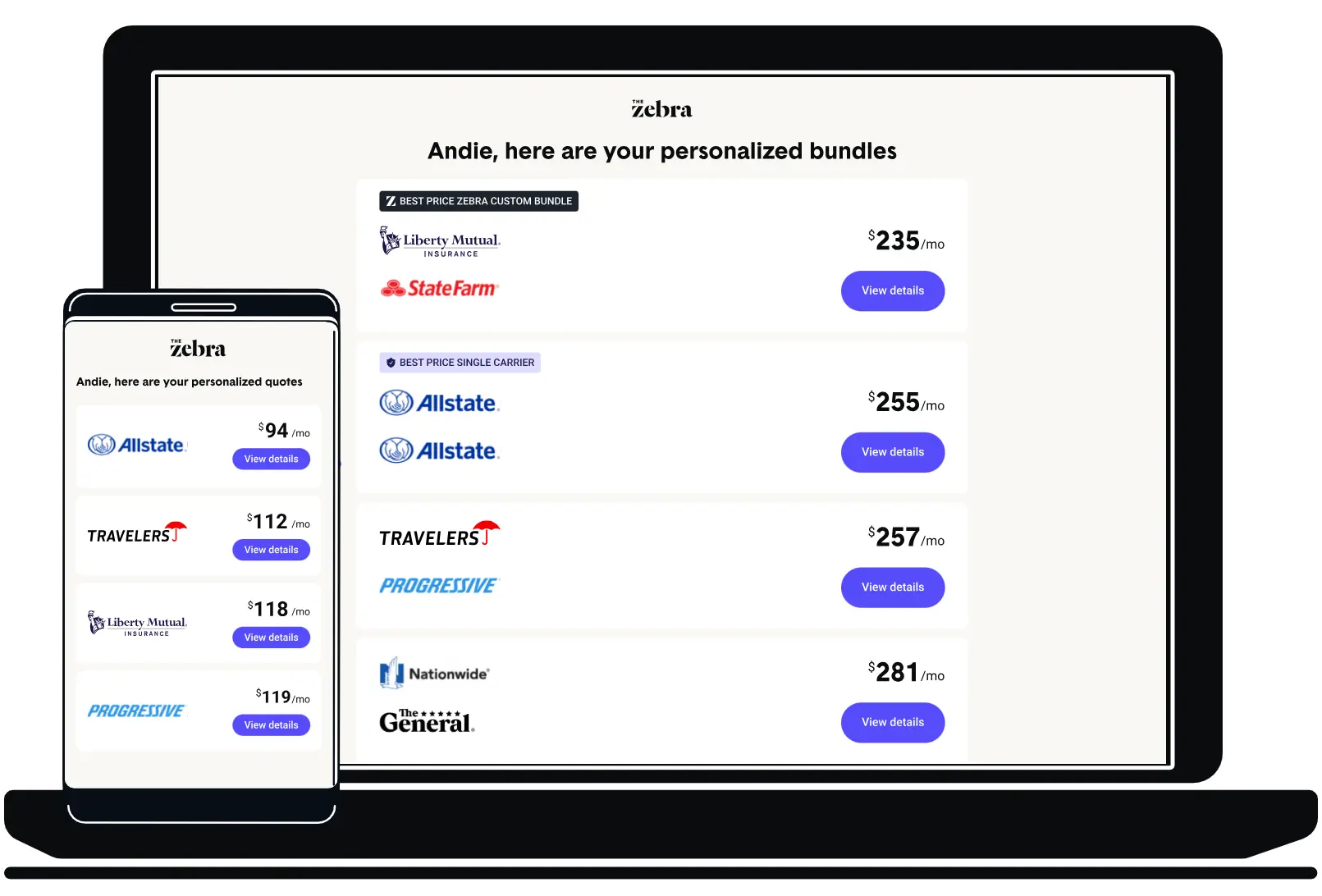
Here at The Zebra, we make it easy for you to find the right coverage—at the right price. We compare top companies so you can find what works for you.





We can also help you:
Government assistance car insurance programs by state
A report by the Consumer Federation of America cited that most uninsured drivers in the United States are considered low-income and are often negatively impacted by actions like raising minimum liability requirements and stiffer penalties[2]. So, if you’re on a tight budget, finding cheap car insurance can help you stay insured.
A few states offer assistance programs for low-income drivers to obtain car insurance protection — let's start here.
California's Low Cost Automobile Insurance Program (CLCA)
California has a program called California’s Low-Cost Automobile Insurance Program, or CLCA, and is designed to provide low-cost insurance rates for eligible drivers[3].
What are the requirements for CLCA eligibility?
- Combined household income, based on the number of people:
- 1 = $39,900
- 2 = $54,100
- 3 = $68,300
- 4 = $82,500
- A good driving record
- No at-fault accidents in the past three years, or be a new driver
- Must be at least 18 years old, or 16 and legally emancipated
- Must own a valid driver’s license
- Must own a vehicle that is valued at less than $25,000
- And, naturally, be a California resident
If you meet the above qualifications and decide to opt to participate in CLCA, your insurance limits for bodily injury liability and property damage liability would actually be lower than the state limits. As participants in this program are exempt from state requirements, your limits would be $10,000 for bodily injury or death per person, $20,000 total for bodily injury or death, and $3,000 total for property damage. Though for an additional charge, the insured can add $1,000 in medical payments per person, $10,000 in uninsured motorist bodily injury per person coverage, and $20,000 in uninsured motorist bodily injury per incident coverage. The amount of the premium ranges based on your insurance history and your county.
Hawaii No Fault Insurance program eligibility
- You must receive financial assistance, supplemental security income benefits, or have received public assistance benefits in the form of medical care prior to July 1, 1994, and are still receiving benefits through the department of human services.
- You have a valid driver's license or are an unlicensed, permanently disabled person unable to operate your own vehicle.
- You are the sole owner of the vehicle being insured.
How to get coverage under the Hawaii No Fault Insurance program:
To recieve coverage from the Hawaii No Fault Insurance program you need to mail or present a certificate of eligibility form to an insurance company under the Hawaii joint underwriting plan.
New Jersey's Special Automobile Insurance Policy (SAIP)
New Jersey’s plan, Special Automobile Insurance Policy (SAIP), provides only the medical coverage portion of your auto insurance after a car accident[5]. Eligibility is dependent upon you already being qualified for federal Medicaid with hospitalization, which an insurance agent can determine from your Medicaid ID card.
How much does SAIP cost and what are the requirements?
SAIP costs $365 per year. This coverage is also contingent upon the annual renewal of your Medicaid benefits. For example, if your Medicaid benefits were to lapse mid-year, your SAIP benefits would continue until the next renewal.
What does SAIP cover?
This coverage pays for emergency medical treatment immediately following an accident, including the treatment of serious brain and spinal injuries up to $250,000. In the event of death, a $10,000 benefit is available.
What doesn’t SAIP cover?
An SAIP policy is for medical coverage only, so comprehensive or collision coverage aren't provided.
New Jersey and Pennsylvania's Citizens United Reciprocal Exchange (CURE)
CURE, or Citizens United Reciprocal Exchange, advertises itself as an insurance provider in New Jersey and Pennsylvania that only uses your driving record as a factor for your rate[6]. It works similarly to other insurance providers in terms of coverage options, discounts, and payment plans.
Maryland's Automobile Insurance Fund
The Maryland Automobile Insurance Fund is a government-created program in Maryland specifically designed to provide liability insurance for residents who cannot receive auto insurance on the open market.[7] Independent from the actual state government, it caters to people who have been denied coverage because of poor or no credit, lapses in insurance, or a poor driving record.
Can you get discounted car insurance using EBT or SNAP benefits?
EBT and SNAP recipients can often take advantage of discounted car insurance programs offered by the state government because the income requirements for both types of programs are similar. However, participation in EBT or SNAP doesn't always automatically grant eligibility for these discounts.
Compare quotes from over 100 providers.
Best car insurance companies for low-income drivers
If you don't live in a state with an assistance program or you don't qualify, your next step should be comparing rates from several car insurance companies. Insurance companies assess your driving profile and their own loss/revenue ratio in order to calculate a premium. This means that your rate with one company isn't the same for all companies. Below are some average rates based on an average driver profile in our methodology. As you can see, rates vary substantially depending on which carrier you choose.
Updating data...
| Company | Avg. 6 Mo. Premium | Avg. Monthly Premium |
|---|---|---|
| GEICO | $956 | $159 |
| USAA | $991 | $165 |
| Progressive | $1,070 | $178 |
| State Farm | $1,168 | $195 |
| Nationwide | $1,184 | $197 |
| Farmers | $1,256 | $209 |
| Allstate | $1,576 | $263 |
Source: The Zebra

These rates reflect a full coverage policy with limits of 50/100/50.
The Zebra’s Dynamic Insurance Rating Tool data methodology
The Zebra’s Dynamic Insurance Rating Tool for home and auto insurance rates utilizes the latest ZIP code-level rate filings from across the U.S., sourced from Quadrant Information Services and S&P Global. These filings, typically updated annually or biennially by insurers, are verified through Quadrant’s QA process and then integrated into The Zebra’s estimator.
The displayed rates are based on a dynamic home and auto profile designed to reflect the content of the page. This profile is tailored to match specific factors such as age, location, and coverage level, which are adjusted based on the page content to show how these variables can impact premiums.
For a comprehensive understanding, see our detailed methodology.

"Weighing out your options will set you up for success. Don't just go with the lowest form of insurance because it's cheap to get started. Discuss a 4-pay plan with your agent: some companies offer a plan consisting of a down payment and four payments, negating the need for a payment in the last month of your policy. This option gives policyholders a break and allows people to prepare for renewals. Use this opportunity to shop around now with a previous insurance discount."
Summer Popovich — Licensed customer service advisor at The Zebra
Car Insurance for Drivers with Bad Credit
Drivers with poor credit pay about 70% more for car insurance. GEICO is cheapest at $260/month. Compare rates from 100+ companies.
Recommended coverage for low-income drivers
To put it simply, liability-only coverage will always be your cheapest option. However, state minimum limits are rarely enough to cover the cost of an accident completely — a totaled car will not get you anything at all from the insurance company — so keep in mind that this choice will cost you more out-of-pocket in the event of an accident.
A minimum coverage policy only covers bodily injury and property damage liability. This kind of policy does not include comprehensive or collision coverage, the costliest parts of any car insurance policy; their inclusion will go a long way in protecting your wallet if a claim occurs.
Most insurance professionals suggest liability limits of at least 50/100/50 in order to be well protected. In most cases, these limits are much higher than what states require.
Updating data...
| Company | Avg. Monthly Premium | Avg. 6 Mo. Premium |
|---|---|---|
| Allstate | $96 | $575 |
| American Family | $87 | $525 |
| Nationwide | $83 | $500 |
| Farmers | $75 | $453 |
| State Farm | $75 | $450 |
| Progressive | $62 | $371 |
| Travelers | $56 | $337 |
| USAA | $50 | $301 |
| GEICO | $48 | $289 |
Source: The Zebra
The inside scoop: Look into regional companies
Sometimes, smaller, more localized insurance companies offer competitive rates for the same amount of coverage provided by major companies. Regional companies often offer other insurance products and discounts, so many of the standard options you're used to with major insurance providers are still available.

Affordable coverage, made easier.
We’ll send you 4 smart ways to find the right insurance at a price that works for you.
Other ways to find auto insurance with a lower income
Insurance companies can’t legally use your income to determine your rate, but they may use other metrics that are often — but not always — correlated to your income level. Car insurance data suggests that people with higher incomes file fewer claims, but that could be because they are able to pay for damages out of pocket rather than filing a claim.
Because these factors are not necessarily within your control, here are some actionable ways to save on car insurance.
Pay for claims out of pocket
Use your car insurance only if the value of damage in an accident exceeds your reasonable ability to pay for it. We understand that this option might not be realistic for someone of limited means, but it's worth exploring whether you'd prefer one hefty bill versus a higher monthly premium for many years. Unless you have some form of accident forgiveness in your car insurance policy, your company will raise your rate for three to five years after an at-fault incident. See below how much common violations would impact your rate.
Updating data...
| Accident/Violation | Avg. Monthly Premium | % Rate Increase |
|---|---|---|
| None | $194 | $0 |
| Not-at-fault accident | $202 | $8 |
| One comp claim | $204 | $10 |
| Speeding 16 - 20 MPH over limit | $244 | $51 |
| At-fault accident - greater than $2000 | $290 | $96 |
Source: The Zebra
Over the course of three years, certain claims could cost you over $2,000 in surcharges. Adding in a $500 deductible, your total amount paid for an at-fault accident is over $2,500. If you have an accident and the out-of-pocket costs are less than $2,500, it makes more financial sense to pay for the damages yourself. Below are helpful guidelines for doing so.
- Get a cost estimate for the repairs.
- Use The Zebra's State of Insurance study to see how much an at-fault accident raised rates in your state, and consider that value over the course of three years.
- Compare the value of the out-of-pocket repairs to the rate increase over three years plus your deductible. If it's cheaper to file a claim, go for it.
Consider usage-based insurance companies
Usage-based auto insurance policies are designed to create your premium based on how you drive rather than who you are. In theory, if you're a safe driver, you can save. But keep in mind that certain telematics programs can raise the premiums of unsafe drivers.
Below are some estimates from popular insurance companies. While not available in every state, these insurtech companies might offer some savings on telematics programs.
| Telematics Program | Estimated Savings |
|---|---|
| Progressive Snapshot | Up to 30% |
| Allstate Drivewise | Varies by state |
| State Farm Drive Safe & Save | Up to 30% |
| Nationwide SmartRide | Up to 40% |
| Liberty Mutual RightTrack | Up to 30% |
| GEICO DriveEasy | Up to 25% |
Avoid letting your coverage lapse
Even small gaps in your insurance history can increase your rates when trying to find a new policy. Our data shows that 29% of Zebra customers are uninsured at the time of application. If you are going to be without a vehicle temporarily, consider purchasing a non-owner policy to keep continuous coverage. That way, your rates will be more reasonable when you are ready to get insurance again.
Double-check for discounts
Although some of the following discounts are automatically added, you will still want to comb through your insurance policy to ensure you’re getting the best auto insurance rates. Here are some of the most common car insurance discounts:

This discount refers to having two types of insurance policies under one insurance company. This is often known as bundling. Common policies are home/auto or renters/auto. The discounts typically affect both your policies.

If you’ve taken a defensive driving course, your insurance company may reward you with a discount on your premium. Learn more about what the big companies will offer you for your good driving record.

If your vehicle comes with an anti-theft device or services like LoJack, your insurance company usually provides a discount.

This discount is typically added automatically to your policy and tends to be beneficial. Just like its name implies, this discount refers to having a safe driving record.

Many insurers offer lower premiums if you have multiple cars on the same policy, which is known as a multi-car discount. Most providers allow you to keep up to four cars on a single policy.

This refers to the method you use to pay for your premiums. While it varies by company, you can usually receive a discount if you pay your premium upfront, pay through your bank account, or opt for paperless billing.

If you pay your insurer your premium ahead of its policy start date, a lot of companies will give you a discount on your premium.

Statistically, some occupations like teachers, physicians, or police officers are less likely to file a claim. Additionally, many companies like GEICO and Nationwide offer discounts to certain groups or organizations. Because of this, some insurers return the savings back to you.
For more information, see our guide to insurance affinity discounts.

Most companies will require the student on your policy to have a GPA above 3.0 in order to receive this discount. You can provide the insurance companies with a transcript or report card for each policy period as proof.
For more information, see our guide to student insurance discounts.

It might be a fairly obvious suggestion, but if you're already struggling to pay for car insurance, you need to take extra care while driving. A poor driving record is a major red flag to any insurance company and could lead to them charging you higher premiums. If you commit a driving violation or get in an accident, you could end up paying surcharges on your premiums for between three and ten years.
Compare companies and find the best policy for your budget.
Zebra tip: Be careful with non-standard carriers
If you are looking for rock-bottom car insurance prices, it's likely that you'll encounter non-standard carriers. A non-standard car insurance company focuses on customers who typically have a high number of accidents or otherwise struggle to find a policy. While coverage may be cheaper, you aren't likely to have as many coverage options and customer service may be lacking.
Bottom line: do your research to avoid companies with poor customer service ratings.
Real people. Real help. Right here.

With a 10-year career in the insurance industry, Jordan brings a wealth of experience in property and casualty insurance. He has experience in both c…
Credentials
- Licensed Insurance Agent — Property and Casualty
- Licensed Insurance Agent — Life, Health and Variable Annuities
- 10+ insurance experience

Erick began his insurance career at The Zebra in 2020, starting in an unlicensed role assisting customers before earning his Property & Casualty lice…
Credentials
- Licensed Insurance Agent — Property and Casualty

Amber Vigil has three years of experience in the insurance industry and joined The Zebra in 2024. As manager, she leads a group of sales agents, ensu…
Credentials
- Licensed Insurance Agent — Property and Casualty
Compare rates and save!
Low-income car insurance: FAQs
Below you'll find answers to some of the most common questions regarding auto insurance for low-income drivers.
About The Zebra
The Zebra is not an insurance company. We publish data-backed, expert-reviewed resources to help consumers make more informed insurance decisions.
- The Zebra’s insurance content is written and reviewed for accuracy by licensed insurance agents.
- The Zebra’s insurance editorial content is not subject to review or alteration by insurance companies or partners.
- The Zebra’s editorial team operates independently of the company’s partnerships and commercialization interests, publishing unbiased information for consumer benefit.
- The auto insurance rates published on The Zebra’s pages are based on a comprehensive analysis of car insurance pricing data, evaluating more than 83 million insurance rates from across the United States.